I believe our understanding of feminism isn’t something we just read in books; it is something that evolves through life and experience. I grew up surrounded by incredibly strong women.
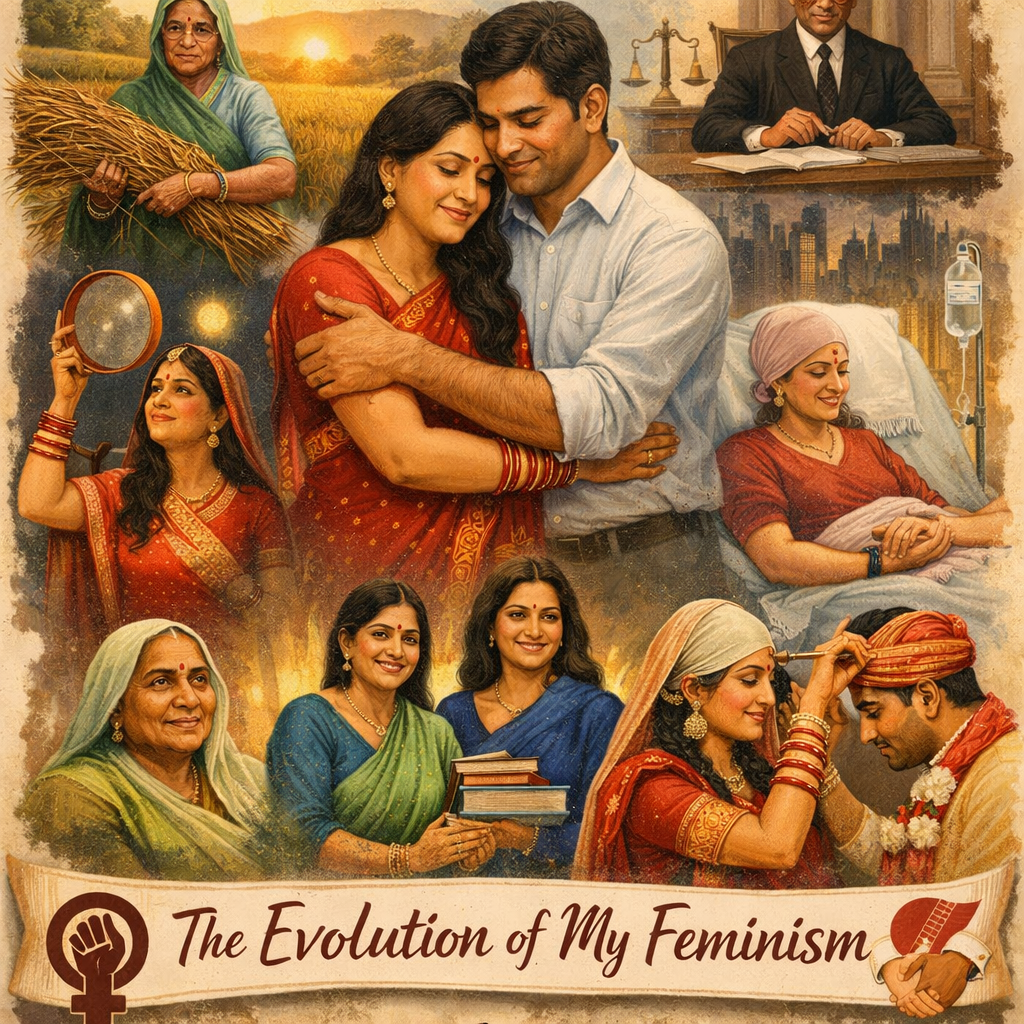
My grandmother was the first in our extended family of farmers to step out and support the work in the fields, in addition to managing the household and the children. She did this to support my grandfather and ensure her children received the education they needed. Because of her hard work, my father became a lawyer, one uncle became a government school principal, and another uncle decided to pursue farming with better equipment and a better life.
When my father started his legal practice in a new city called Muzaffarnagar, in the state of Uttar Pradesh, we struggled. I still remember living in a distant small town called Shamli, in a single room that served as his office by day and our kitchen and bedroom by night. To help us survive, my mother began giving private tuitions, traveling from home to home while managing our household. Despite the hardships, she never stopped learning. She completed three separate Master of Arts (MA) degrees in an era when education for girls was still a distant dream for many, eventually securing a job as a government school teacher.
It was my mother’s sweat and dedication, alongside my father’s hard work, that allowed my brother and me to build successful lives.
Then, I married Kusum. She was the strongest of all.
Based on my respect for the women in my life, I had developed my own rigid “rules” for what feminism should look like. I thought changing a surname after marriage was wrong. I thought traditions like Karwa Chauth – a festival where a wife fasts and prays for the long life of her husband – were regressive. To “protect” her, I intentionally didn’t have Kusum’s surname changed.
But over time, I noticed something unexpected. In the college where she was working as an Associate Professor, and in many other places, she began signing her name as “Kusum Tomar” instead of Kusum Malik. I realized she wasn’t doing it out of pressure; she was doing it out of love. She loved being a wife; she loved the nuances of our culture, the sindoor, and the rituals.
The biggest lesson came through Karwa Chauth. I used to try to stop her from fasting – initially due to my own understanding of feminism, and later because of her battle with cancer. I would even fast in her place to support her beliefs, after her diagnosis with Cancer. But during her last Karwa Chauth before her death, even though she was very ill, she fought with me because she wanted to keep that fast. It was her choice, her faith, and her way of expressing love.
Those were the moments I realized that my desire to protect her was just the first step. The next step was understanding that true support means honoring her choice. Whether she chose to break a tradition or embrace one, my role was to stand by her and celebrate her.
I feel fortunate to have been shaped by such remarkable women. From my grandmother’s fields to my mother’s classrooms and Kusum’s courageous spirit, I have tried my best to learn from them and to stand with them. Today, I see feminism not just as a set of ideals, but as a deep, evolving respect for the path a woman chooses for herself.
I am proud of that journey, and I will continue to stand with the women who are and will be part of my life – with mutual respect, shared values, equality, support, understanding, and companionship.
Feminism #NariShakti #StrengthOfAWoman #IndianFamilies #LifeLessons #LegacyOfLove #KusumMemorial #GrowthMindset #ChoiceAndDignity #MenForEquality #RespectWomen

 Rise To Survive Cancer