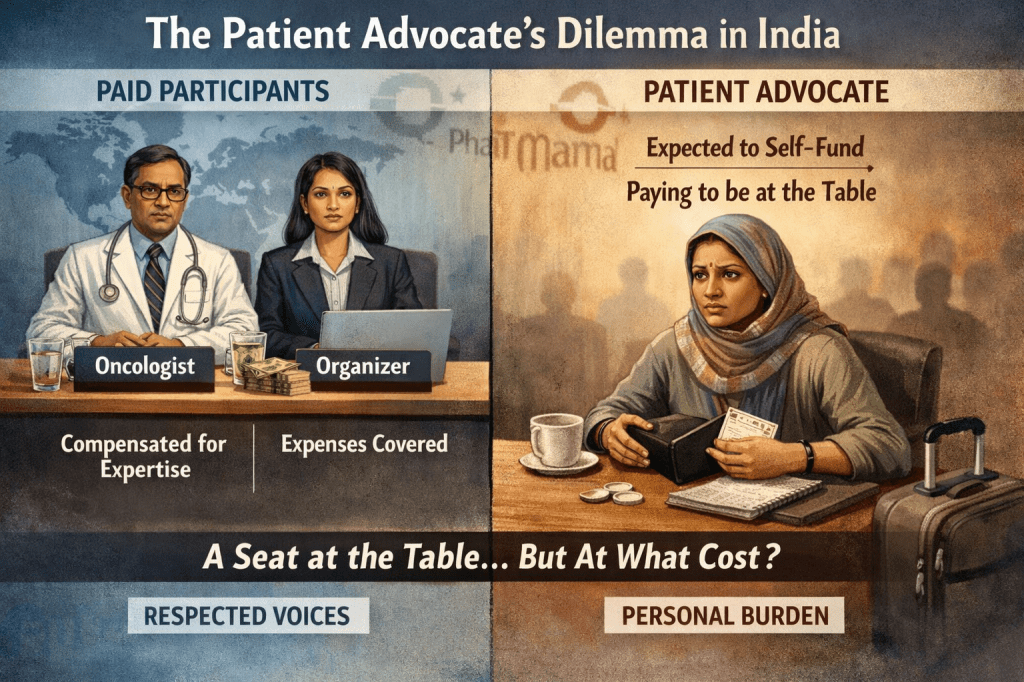
The Price of a Seat at the Table

In the global oncology landscape, “Patient Centricity” is everywhere. It’s on corporate banners and in mission statements. But as a patient advocate in India, I often find myself asking: Who is paying for the dignity of that seat at the table?

In the West, it is increasingly standard for pharmaceutical companies and non-profits to offer honoraria to patient advocates. They recognize that lived experience is a specialized, unique expertise that cannot be found in a textbook.

The Reality in India: Inclusion or Illustration?

In India, the story is very different. With rare exceptions, most organizations – including global pharma branches and well-funded non-profits – often treat patient advocates as ornamental rather than essential.

While everyone else in the room is there in a professional capacity, advocates are frequently expected to provide their time and insights for free. Even more concerning is when sponsored events fail to cover basic logistics or travel. In these scenarios:

  • The Oncologist is compensated for their clinical expertise.
  • The Organizer is compensated for their coordination.
  • The Patient Advocate is often expected to self-fund their participation, essentially paying out of their own pocket to represent a community that is already struggling.

The Advocate’s Dilemma

This creates a painful choice:

  • Keep attending: We maintain our hard-won seat at the table, but we risk validating a system that treats our lived experience as a “nice-to-have” add-on rather than a core contribution.
  • Stop attending: We lose our influence, and the conversation reverts to an era where decisions are made about us, without us.

From “Showpiece” to Partnership

We will always be volunteers for our cause – that is where our heart is. But there is a line between volunteering for patients and being used as a showpiece for a corporate agenda. We shouldn’t have to choose between our dignity and our impact. True partnership means that if an advocate’s voice is essential enough to be on the agenda, it is essential enough to be respected with the same equity shown to every other expert in that room.
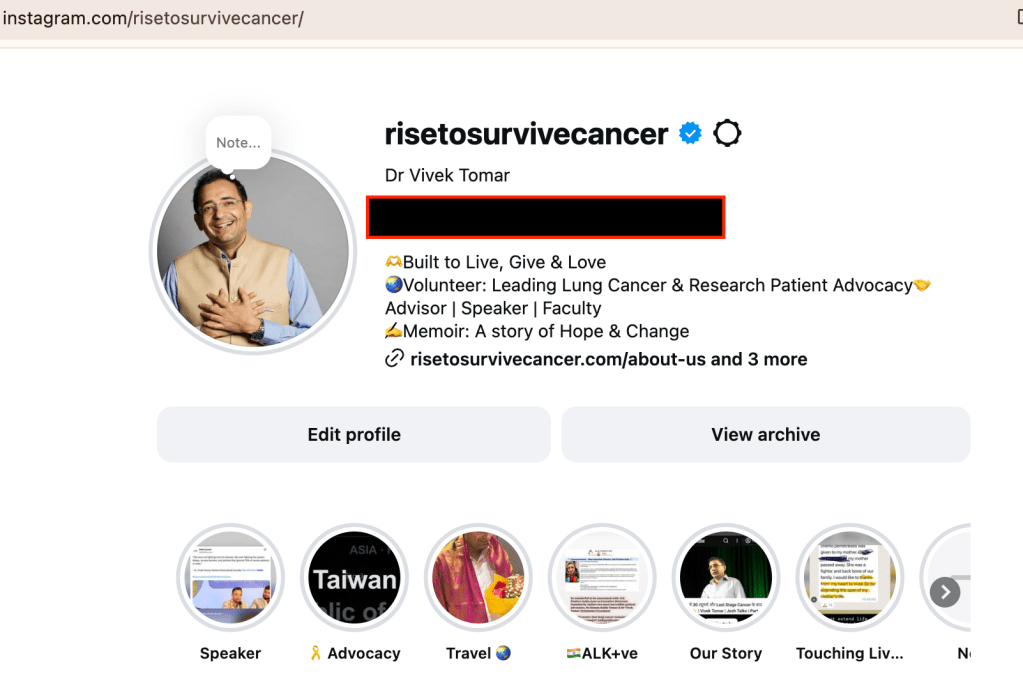
Beyond the Page: Bringing our Mission to Life on Instagram too

The Power of Connection For years, this blogsite has been a sanctuary for my community – a place where we dive deep into lung cancer research, patient advocacy, and the global policy changes we need in LMICs and beyond. It has been a privilege to connect with readers from 50+ countries.

But as now I work on the memoir for Kusum and push through my own 50-day journey of resilience, and that volunteer work of patient advocacy isn’t just about the words we write; it’s about the lives we lead every day.

Why Instagram? Why Now? I have decided to launch a dedicated public Instagram profile: @risetosurvivecancer.

While this blog will remain the home for my long-form research updates and detailed advocacy reports, Instagram will be the “Live Newsroom” of our mission. It’s where I will share:

  • Daily Resilience: Real-time updates from my 50-day fitness and advocacy challenge.
  • Behind-the-Scenes: Insights into the research lab, global conferences, and the making of the memoir.
  • Travel & Hope: Clips from my journeys (like the recent trip to South Africa) that show the human side of this fight.
  • The Memoir Journey: Exclusive snippets and reflections from the book I am writing for Kusum.

Keeping the Focus I want to be clear: the technical depth and global advocacy work you value on this blog aren’t going anywhere. Instead, Instagram allows a space for us to interact more closely, share quick wins, and build a more visible movement.

Join the Conversation If you have been part of this global community, I invite you to join me on this new platform too. Let’s make our collective voice even louder.

Link to connect at Instagram: https://www.instagram.com/risetosurvivecancer/

Vivek

Why Speaking Up for India and LMICs in Global Healthcare is Non-Negotiable

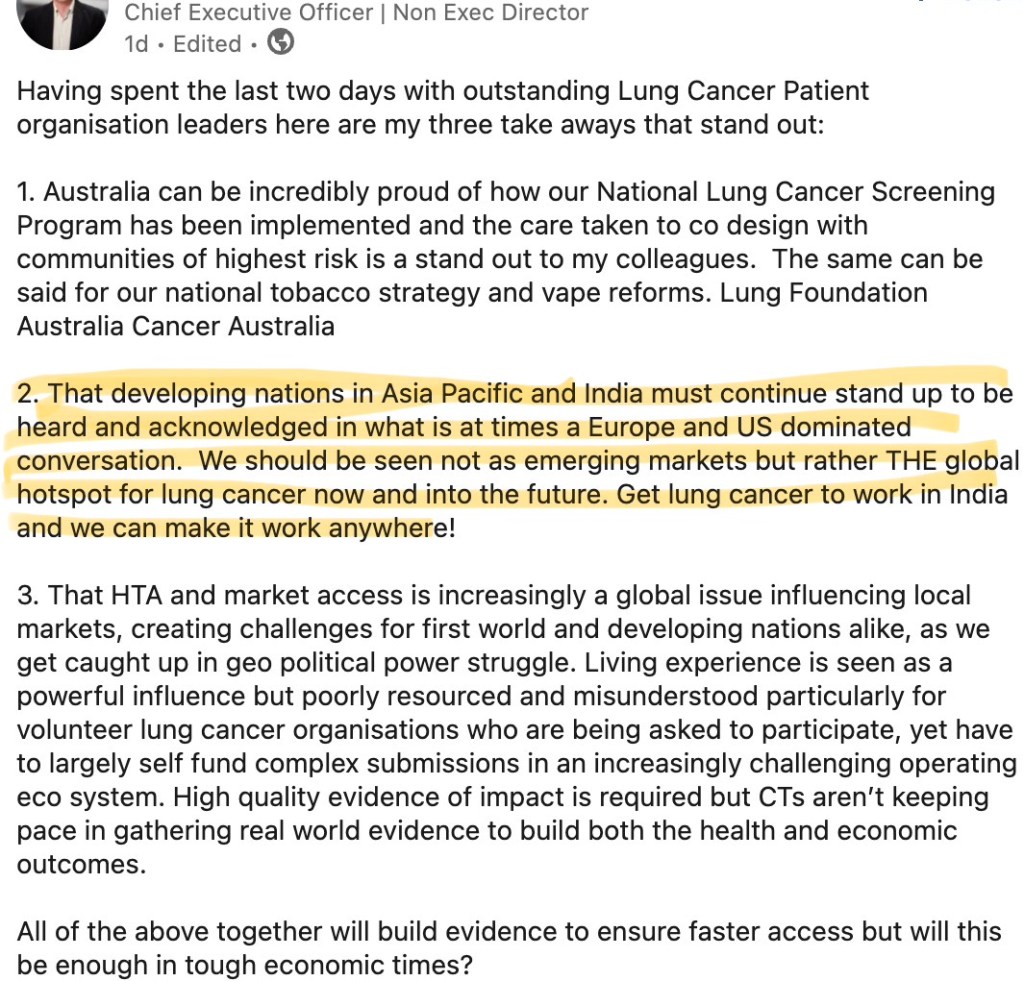
I recently had the privilege of representing India at a global advisory board meeting for lung cancer. These meetings are vital for shaping the future of oncology, yet a familiar pattern emerged: the discussion on “access” was almost entirely dominated by the landscapes of the US and the European Union.

While the challenges in those regions are real, “access” takes on a completely different meaning in India and other developing nations. In our context, it isn’t just about administrative hurdles; it’s about the fundamental availability of life-saving innovation for millions who are often left out of the global conversation.

The Power of the “Living Experience”

During the sessions, I made it a point to politely but firmly steer the conversation toward the missing voices of India and LMICs. It is easy for global boards to view these regions as “emerging markets,” but the reality is that we are the global hotspots for lung cancer. If we can solve the access puzzle in India, we can solve it anywhere.

I was heartened to see this message resonate. Shortly after the meeting, a senior colleague and representative from Australia shared his takeaways on LinkedIn, specifically highlighting that developing nations in Asia Pacific and India must continue to stand up to be heard.

Why Your Voice Matters

This experience reminded me of three critical truths for advocates:

  • Visibility is the first step to Access: If we aren’t at the table – or if we stay silent while at the table – the world will continue to design solutions that don’t fit our reality.
  • Data + Experience = Impact: Combining Health Technology Assessment (HTA) with the “living experience” of patients creates a narrative that even the most complex geopolitical or economic systems cannot overlook.
  • The Ripple Effect: When you speak up, you aren’t just influencing the person across from you. You are providing the language and the courage for other leaders to carry that message back to their own countries.

Moving Forward

Advocacy is often a long, uphill climb, but seeing the immediate impact of a single intervention at a global meeting is a powerful motivator. We must continue to demand that the global oncology conversation reflects the global reality.

Our voices are not just “participation” – they are the essential evidence required to build a more equitable healthcare future.

No One Should Fight Alone!

Vivek