I recently had the privilege of representing India at a global advisory board meeting for lung cancer. These meetings are vital for shaping the future of oncology, yet a familiar pattern emerged: the discussion on “access” was almost entirely dominated by the landscapes of the US and the European Union.
While the challenges in those regions are real, “access” takes on a completely different meaning in India and other developing nations. In our context, it isn’t just about administrative hurdles; it’s about the fundamental availability of life-saving innovation for millions who are often left out of the global conversation.
The Power of the “Living Experience”
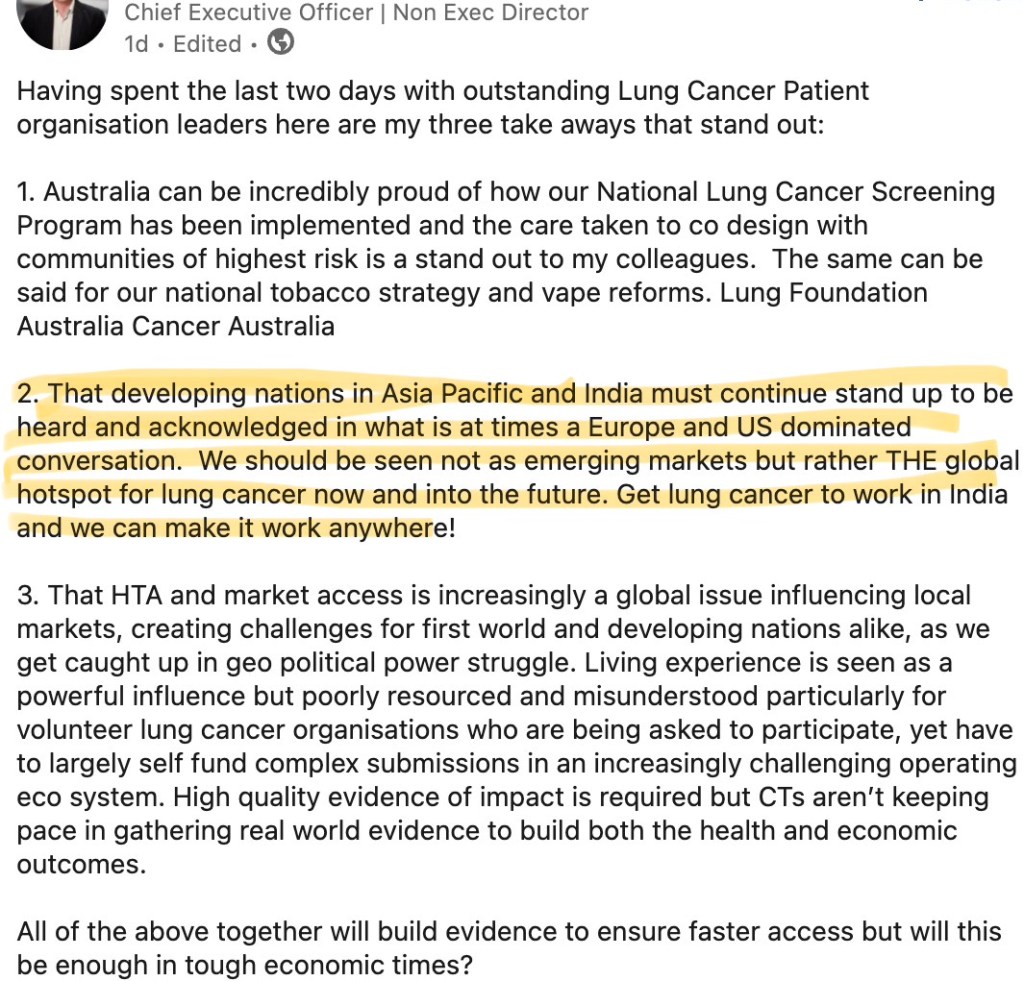
During the sessions, I made it a point to politely but firmly steer the conversation toward the missing voices of India and LMICs. It is easy for global boards to view these regions as “emerging markets,” but the reality is that we are the global hotspots for lung cancer. If we can solve the access puzzle in India, we can solve it anywhere.
I was heartened to see this message resonate. Shortly after the meeting, a senior colleague and representative from Australia shared his takeaways on LinkedIn, specifically highlighting that developing nations in Asia Pacific and India must continue to stand up to be heard.
Why Your Voice Matters
This experience reminded me of three critical truths for advocates:
- Visibility is the first step to Access: If we aren’t at the table – or if we stay silent while at the table – the world will continue to design solutions that don’t fit our reality.
- Data + Experience = Impact: Combining Health Technology Assessment (HTA) with the “living experience” of patients creates a narrative that even the most complex geopolitical or economic systems cannot overlook.
- The Ripple Effect: When you speak up, you aren’t just influencing the person across from you. You are providing the language and the courage for other leaders to carry that message back to their own countries.
Moving Forward
Advocacy is often a long, uphill climb, but seeing the immediate impact of a single intervention at a global meeting is a powerful motivator. We must continue to demand that the global oncology conversation reflects the global reality.
Our voices are not just “participation” – they are the essential evidence required to build a more equitable healthcare future.
No One Should Fight Alone!
Vivek

 Rise To Survive Cancer